
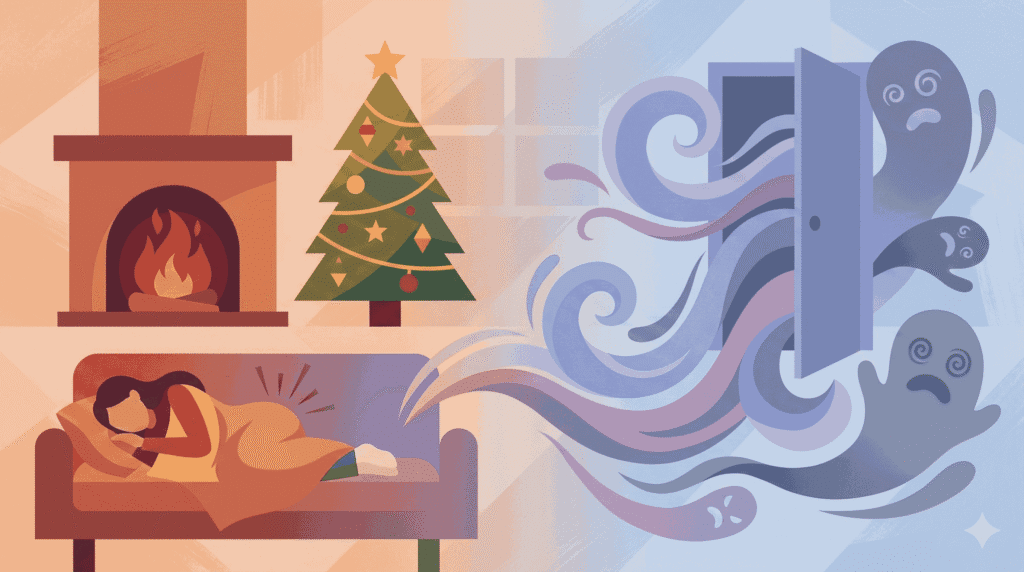
The fire glows in the wood-burning stove, singing its special carols and spreading warmth. In the corner, the tree is waiting patiently for you to put its shimmering festive coat on. The entire living room seems to lean in, ready to hold you for a while. Even the kitchen seems excited about all the goodies that you are going to bake. A smile moves to the corners of your mouth and, just like a cat, you are stretching under the blanket, dreaming of another white, beautiful Christmas.
But there is a whoosh, like a door suddenly opening and letting crisp cold air in. Along with it, something else entered and shifted the energy in the room. The thoughts that were soft a moment ago now turn sharp: “What if the fire goes out? Do I really have to put all those decorations up and stand for hours to cook the dishes for the holiday meal?” Just thinking about it now tires you and saddens you. Your stomach tightens when you remember that you do not have to cook, because you are spending Christmas Day at someone else’s place. What? That is even worse. How did we get here, you wonder? If this were a Charles Dickens story, this is the part where the ghosts start knocking.
This article is about what it’s like to face Christmas with chronic pain, when the season you once loved starts to feel like a test.
My Story: The Ghost of Christmas Future
Christmas for me was as magic as the first day of snow, as exciting as turning on the lights on the tree. It brought the same peace I felt singing carols with the choir in the mansard of my childhood village church. And it had the sweetness of the freshly baked donuts my mom would powder with sugar. Travel and gatherings? Yes, please. The adrenaline of shopping on December 24th, shoulder-to-shoulder with half the city? I loved the rush. Late nights? Bring it on.
But since chronic pain arrived in my life, I am relieved when people cancel plans. The thing with the holiday season, though, is that events almost never get cancelled. You feel you have to be there. Your stomach knows it, your shallow breathing knows it, and the need to dissociate tells the same tale.
My first Christmas with this condition felt like racing through fog. I had my ‘runner outfit’ on; I knew I had to run, but I could not see where I was heading. Some dear friends invited me over, and even though I tried to take time for myself – going on long walks, skipping gatherings – it didn’t work. I was blinded most of the time by the fear of ruining the event for me and others. The dread was building up, and so was the pain. My friends were giving me space, but I was the one talking myself out of it: “Can’t you see you’re getting worse every day?” Don’t you want to be at your place, away from anything that starts with: I have to…?!”
All the sitting, the talking, the noise contrasted with the only thing my body wanted: lying down on a cozy sofa and having as much “nothing” as possible. I was feeling at peace only when going to bed at night, but after two or three days, that was no longer the case. Even now, writing this, I feel relief at the memory of going home; the same relief I felt seeing the lights of my village from up the hill. I was back in my space, alone, but safe.
I did not know I had chronic pain. I could feel that something was really off, but I had no explanation for why I was not “normal”, cheerful, full of energy and glee. Limits for me were also unknown. I believe the survival instinct was the only thing pushing me around or taking me out of situations. For good or bad.
Three years have passed, yet the ghost of that first Christmas continues to haunt every holiday season. The fear starts when the questions normally start: “What are you going to do for Christmas?” “Are you coming over for Christmas?” “On Christmas, we have to…” Anxiety rises and symptoms creep in. My mind projects such vivid disaster scenarios that just thinking about them triggers spikes of actual pain. Of course, my body feels scared.
Turning the tables takes time, but I can start with the chairs. This year, I decided quite early what I am going to do that day, but most importantly, what I am going to do in the time leading up to it. I still want to feel joy at this time of year. I refuse to give it away. It would be like forgetting my grandmother’s smile when she was calling me to have some hot milk on freezing carolling evenings. It would be as sad as never seeing snow in my life again. We can’t have that now, can we?!
So no matter where I am, I will give my body ways to cope, breaks and ways out. I guess I have started carefully, already asking people to give me time to think about where I am going to spend the day. The first step was turning my house into a cocoon: books stacked by the tree, a queue of movies ready to go, and small everyday treats within reach.
Another thing: I am asking for help and for a bit of quiet teamwork, because it is a pity to lose an entire month for a few days you are dreading. Something big changed in my life when my body started hurting, so it is only natural that other big changes should follow to accommodate this new and scary state of things. Looking back, that first Christmas with friends was my first visit from my Ghost of Christmas Future.

The quiet monsters: what I’m actually afraid of
When I look closely, the fear I feel around the holidays isn’t one big monster. It’s a handful of quiet, very specific worries.
Not coping physically. I worry that my body won’t keep up with what the days expect from me. Sitting or standing for too long, changes in routine; all of that comes with a cost I already know. I worry about reaching the point where my body clearly gives up while the day still goes on.
Being judged or misunderstood. There is also the tension of how it might look from the outside. The comments about not helping enough or being too quiet, about weight or mood. The “But you were fine last year,” or “You look okay to me.” I’m concerned that people will see laziness where I feel limits, and attitude where I feel symptoms.
Disappointing people and being “too much”. Another worry is letting people down. Saying no to an invitation, leaving early, needing to lie down, not bringing enough “Christmas spirit”; I imagine myself as the one who changes the mood, the complicated one, the person others have to adjust to.
Losing my place. Underneath that sits a quieter anxiety: that if I can’t show up like I used to, I’ll slowly stop being included. People will see choosing a smaller Christmas as choosing less connection. My “no” to an activity means I’m saying “no” to the relationship.
Old roles and family patterns. Then there is the unease about slipping back into old roles that no longer fit: the one who helps with everything, the peacemaker, the person who absorbs tension so others can relax. My body and my life are different now, but they will expect me to step into those familiar scripts.
Betraying myself and the resentment. This is perhaps the scariest one. I am terrified that if I give in to the pressure and do what others want, I will lose my sense of self. There is a specific danger in saying “yes” when my body is screaming “no”; it feels like a betrayal. I worry that if I keep swallowing my reality to keep the peace, that silence will turn into resentment; towards them for asking, but mostly towards myself for abandoning my own needs.
Naming these fears and worries like this helps me understand why the holidays can feel heavy long before they actually arrive.
A Small Shift: What I Wish Someone Had Told Me
After living through a few Decembers like this, a simple change in perspective has helped me. Instead of treating my reaction to the holidays as a personal failure, I try to hold on to a few simple truths.
I am writing these down for both of us. Take what fits, leave what doesn’t.
- Fear of the holidays is a completely valid human response.
- Your body’s fear is information from everything you’ve already lived.
- You can put your body first and shape Christmas around your actual capacity.
- Resting at home is an inherent right and a vital act of self-care.
- You don’t have to perform joy to be a good person.
- Leaving early to tend to your body is a healthy choice that allows everyone to have their needs met in their own way.
We’ll talk about the “why” and the “how” in the next part.
Gentle Guide: Living Through Christmas With Chronic Pain
Why chronic pain and Christmas are such a heavy mix
So far I’ve talked about how Christmas feels from the inside. There is another layer to this: how a body that lives with chronic pain learns from what has already happened. Bodies are very good at noticing patterns. If several Decembers ended with you wiped out in bed or cancelling plans because you couldn’t move, your system keeps track. When the calendar turns to December, your body doesn’t see a blank space. It recognises a period that has been dangerous before and quietly starts getting ready.
Pain scientists call this predictive coding. Your brain isn’t just reacting to what is happening now; it is predicting what will happen based on the past. That preparation shows up as tighter shoulders, lighter sleep, and pain that seems to turn up a notch even on quiet days. This is part of the fear-pain cycle that keeps your nervous system on high alert.
Seen from this angle, your reaction to the holidays is actually your body trying to protect you. It has learned that this season is “high-risk,” so it turns up the volume on symptoms. This amplification process is often called central sensitization. That doesn’t fix the pain, but understanding it is the first step in moving from fighting yourself to supporting yourself.
And this is where we can learn a new way to be together.

Name your Christmas this year
The most important change happens before you even look at a calendar. It is a quiet shift from asking, “How do I survive everything?” to asking, “What actually matters to me this year?”
Before thinking about plans, it helps me to pause and decide what this particular Christmas is actually for. Not the marathon I used to have, not the one other people expect, but this one, in the body and life I have now.
You don’t have to map out everything. Sometimes it’s enough to sit with a few simple questions like:
- If I only had energy for one part of the festivities this year, what would I choose?
- Which traditions still feel nourishing, and which feel more like a performance I’m expected to give?
- How can I honor my limits this year so that I can be fully present for the moments I choose to attend?
You can write down one to three priorities just for this year. This isn’t a contract for the rest of your life; it’s a way to give this December a shape that fits your current reality better. If your answers point to a quieter or more simplified version of Christmas, it means you’re letting how things really are have a say in how you spend your time.
In the next step, we’ll look at how to build a “good enough” plan around whatever you choose.
Planning Christmas Around Your Body (Not the Other Way Around)
Once you know what you want to do, the next step is figuring out how to do it without paying for it until February. Navigating a Christmas with chronic pain isn’t about having a stricter schedule; it’s about creating a softer one. We want to replace the “push and crash” cycle with a rhythm that feels sustainable. These are ways to send continuous safety signals to a nervous system that is on high alert.
Here is how to build a plan that keeps the monster at bay:
1. The “Sandwich” Method (Energy Planning) The biggest mistake we make is stacking events back-to-back. Instead, try “sandwiching” every big activity between two layers of rest.
- Space it out: if you have a family dinner on the 25th, block out the 24th and the 26th as “low-sensory” days. Your nervous system needs that downtime to process the excitement and reset the baseline.
- Decide the duration in advance; don’t wait to see “how you feel in the moment”; adrenaline often masks pain until it’s too late. If you know your limit is two hours, plan to stay for two hours. It is better to leave while you still have a little battery left than to be carried out when it hits zero.
- One major event per day: if you have a lunch gathering, the evening is for pajamas and movies.
2. Create “Safety Pockets” You don’t need to leave the house to find relief; you just need to know where you can retreat if the noise or symptoms rise.
- Scout the quiet zone: when you arrive, identify a quiet corner, a guest room, or even a patio where you can step away. Knowing the escape route exists often lowers anxiety even if you never use it.
- The 10 min reset: you don’t need a nap to reset your nervous system. A “micro-break” like lying down flat for ten minutes, changing your posture, or stepping outside for fresh air, can be enough to interrupt the wind-up of pain signals.
3. The Graceful Exit Strategy Fear of being “trapped” at an event is a huge pain trigger. Remove that fear by planning your exit before you even put your coat on.
- The “Pumpkin Hour”: set a departure time that is non-negotiable. It helps to tell your host in advance: “I can’t wait to come, but I’ll need to head off by 4 pm to manage my health.” This manages expectations, so there is no awkwardness when you stand up to leave. Setting boundaries like this it’s about protecting your energy.
- The Bat-Signal: if you are going with a partner or trusted friend, agree on a subtle signal – a specific phrase or gesture – that means “I am fading, please help me wrap this up.” Knowing someone else is watching out for your limits allows you to relax and actually enjoy the conversation.
4. When there is no exit door (Hosting & Family) When the noise and demand are coming from your own living room – kids, guests or a kitchen full of food – you can’t just “leave.” But you can still create pockets of space.
- The “Traffic Light” System: establish a clear visual signal with your husband and kids. If the bedroom door is closed (or you are wearing your “quiet headphones”), it means Red Light: Do not disturb unless it’s an emergency. This gives you a sensory break without leaving the building.
- The “Horizontal Host” questions: who says hosting requires standing? You can chop vegetables while sitting at the table, or supervise the kids opening presents while lying on the sofa. Lowering your center-of-gravity signals safety to your body.
- Radical Outsourcing: if cooking a full meal feels like climbing Everest, redefine the menu. Order in, buy pre-chopped ingredients, or ask guests to bring a dish (potluck). Your contribution is the space and the love, not necessarily the manual labor.
Remember, this structure is here to convince your brain that you are safe, so it doesn’t feel the need to protect you with pain.
In the Room: Anchoring When the Volume Rises
Even with the best plan, the actual event can be triggering. When you are in the middle of a Christmas with chronic pain, you need tools that are invisible to others but powerful for you.
Here is how to stay grounded.
Find your “safe human” Pain science tells us that isolation increases threat perception. You don’t have to do the heavy lifting of regulating your nervous system alone.
- The Anchor: find one person in the room whose energy feels calm. You don’t even have to talk to them about your pain. Just standing near someone you trust or making eye contact, allows your nervous system to “borrow” a bit of their safety. This is biological co-regulation in action.
Watch for the “yellow light” We often ignore our body until it screams (red light). But the body usually whispers first.
- The Subtle Signals: before the pain spikes, you might feel sudden brain fog, irritability, a clenched jaw or the urge to “check out” of the conversation.
- The Action: treat these as yellow lights. They are just your body asking for a pause. This is the moment to use the “Safety Pocket” or “Micro-break” we planned earlier. Catching it here saves you from a crash later.
The “Closing Ceremony” This is the most overlooked part of the night. When you get home, your brain might still be buzzing with “high alert” energy, waiting for the next threat. You need to manually switch the system off.
- The Ritual: don’t just collapse into bed in your party clothes. Create a deliberate separation between “The Event” and “Rest.” Change into soft clothes immediately. Wash your face (water cools the vagus nerve). Say out loud or think clearly: “The event is over. I am home. I am safe now.” This simple ritual closes the stress cycle and allows your body to actually begin recovering.
The Day After: Coping with the Emotional Crash
There is a specific kind of hangover that comes with a Christmas with chronic pain, and it has nothing to do with mulled wine. It is the “Vulnerability Hangover.” After the effort of socialising, managing symptoms or setting boundaries, it is common for the brain to suddenly flip into critique mode. You might find yourself replaying conversations, wondering if you complained too much, or telling yourself you “ruined the vibe” by leaving early.
This isn’t because you did something wrong. It is your nervous system checking for safety. After a period of high stimulation, the brain scans for errors to prevent future rejection. Unfortunately, with chronic pain, this scan often feels like shame.
Here is how to stop the spiral before it ruins your recovery day.
Separate the fact from the story
When the inner critic starts loud, it usually speaks in judgments (“I was a burden”). We need to strip it back to observations.
- The story: “I was such a mess, everyone probably wished I hadn’t come.”
- The fact: “I had a pain flare at 3 pm and asked to lie down for twenty minutes.”
The Reality Check
Instead of letting your mind run a loop of criticism, sit down and force your brain to answer three specific prompts. This moves you from emotional blaming to “owning your own part” with compassion.
- Name what actually happened: “I left the dinner two hours earlier than everyone else.”
- Name what you protected: “I protected my nervous system from hitting the ‘Red Zone’ so I wouldn’t spend the next three days in bed.”
- Name what still hurts (without fixing it): “I feel sad and a bit guilty that I missed the games. I worry they think I’m boring.”
Offer yourself a kinder sentence
Finally, close the reality check with a statement that validates your experience. We often judge our choices in pain against the capacity of a healthy person.
- The Shift: Instead of saying, “I should have stayed longer,” try: “Given the physical reality I am navigating right now, this was a reasonable and kind choice.”
You can grieve the limitations while keeping your self-worth intact. You navigated a difficult situation with the resources you had.

The Sanctuary Choice: When Staying Home is the Answer
Sometimes, the “Sandwich Method” isn’t enough. Sometimes, the only safe answer for a Christmas with chronic pain is to stay home entirely.
We already established that this is a valid choice. The challenge now is living with it while the rest of the world is posting photos of the party.
Here is how to navigate the specific emotions of the day you stay behind.
Managing the “Ghost of Missing Out”
The hardest part of staying home it’s the internal conflict. You might feel a wave of intense relief (that you can stay in pajamas and not hurt) followed immediately by a wave of sadness (that you aren’t there).
- The Reframe: don’t talk yourself out of the sadness. It is possible to be grateful for your safety and grieve the loss of the moment at the same time. Let the relief protect your body, and let the sadness just be a passing visitor, not a permanent resident.
Connection Without Proximity
The fear of the “empty chair” is often a fear of disconnection; that “out of sight” means “out of mind.” But connection is about energy, not just geography.
- The Invisible Thread: You can still be part of the fabric of the day without physically crossing the threshold. Send a specific text at a specific time (e.g., “Thinking of you while you open presents”). Ask someone to send you one photo of the dessert. This keeps the bridge open so they don’t feel like you have vanished from their lives.
The “Sanctuary” Mindset
If you view staying home as “being stuck,” the pain often amplifies because the brain senses a trap. If you view it as “entering a sanctuary,” the nervous system settles.
- Active Choice: curate your environment. Light a candle, put on the softest blanket you own, or play an audiobook. Make your space feel like a protective cocoon you built on purpose, rather than a cage forced into.

Christmas & New Year Q&A (Chronic Pain Edition)
Yes, it’s very common for Christmas to feel “too much” when you live with chronic pain, even if parts of it are enjoyable. When symptoms are high, the goal shifts from “doing everything” to “getting through this time with as little extra damage as possible.” Having a plan for flare-ups can help you navigate these intense moments without panic.
You can help yourself by:
Treating coming home and crashing as part of the plan. Build in decompression: comfortable clothes, prescribed medication, heat, a simple meal, and as few decisions as possible.
Cutting your plans down, sometimes a lot. One main activity per day may be enough. Fewer events or tasks often means fewer huge flares.
Deciding your exit in advance. Pick a time or clear signs (rising pain, fog, irritability, overwhelm) that mean, “I lie down, step outside or leave now,” even if others want you to stay.
Carrying a small “safety kit”. Meds as prescribed, heat or cold packs, water, earplugs, a cushion, braces or supports. Having what you need close by is self-care.
Allowing “not this year” as an actual option. Skipping some plans can be a health decision because you are living it in a sensitive body that pays for every extra demand.
Many people with chronic pain reach a point where decorating, cooking, going out or even putting up the tree feels like too much. Loosing those rituals can leave a strong feeling of emptiness.
You might try:
Shrinking the task while keeping a piece of the joy. Maybe this year it’s just the tree and one string of lights. Or a few favourite decorations in one corner. Christmas does not have to be “all or nothing.”
Letting “good enough” be the standard. A late, uneven, half-done Christmas still counts. With chronic pain, every step costs more energy than most people see.
Asking for help if there is someone safe to ask. “I still want a bit of Christmas feeling at home, but I can’t do it alone. Could you help with the lights or a few decorations?”
Lowering the emotional bar. Instead of aiming for joy, aim for “less pressure,” “a bit more comfort” or “one or two moments that feel okay.”
Creating one small thing just for you. A simple meal, a favourite film, a quiet walk, a call with a supportive person. It will not erase the sadness, but it gives the season a point of reference.
Feeling flat or miserable at this time of year is a very common response to living with chronic pain, not a sign that you are doing life badly.
Yes. Large meals, sugar and simple carbs, long sitting, loud gatherings and overstimulation often increase pain and fatigue, especially with conditions like fibromyalgia.
A few adjustments:
Change holiday food in ways that feel realistic. Smaller portions of known trigger foods and more of what feels “safer” for your body can already lower the impact.
Redefine what “joining in” looks like. You do not have to play every game or stay at the table the whole time. You might join for one round, then sit on the sofa, or just be nearby and listen.
Plan rest as part of the schedule. Decide ahead: “I’ll be with everyone for a bit, then I’ll lie down.” This is pacing; caring for your body may be the only reason you can be present at all, even in a reduced way.
This mix of symptoms, new family dynamics and pressure to appear “fine” is very common.
You can ease some of the strain by:
Having an honest conversation with your partner first. Explain that hiding your illness completely increases your stress and can worsen symptoms. Ask what they are most afraid of and look for a middle ground.
Agreeing on a short, neutral explanation. You don’t need to give details. A simple line like, “I’ve been dealing with some health issues, so I may need to sit more or take breaks,” often sets the scene without a big conversation.
Planning practical support. Decide together how long you’ll realistically stay, where you can rest if overwhelmed, and a signal that means “I need a break” or “I need to leave soon.”
Letting go of the idea of a perfect performance. If you are quieter, need breaks or leave earlier, that does not mean you spoiled anything. It means you listened to your body.
Honesty plus small, concrete plans usually makes the day feel less like a test.
Christmas markets and fairs typically mean lots of walking, standing, queues, noise and cold. With chronic widespread pain, that can be tough, but some preparation can help.
Consider:
Planning around your feet, joints and back. Wear your most supportive shoes. Use braces or supports if they help you. Sit whenever you see a chance: benches, cafes, low walls.
Breaking the outing into blocks. Instead of “I’ll spend the whole day there,” think in pieces: morning / midday / afternoon. Decide in advance when you will rest, even if you feel okay at that moment.
Checking what the place offers. Look for seating areas, quieter spots, indoor cafes, first aid points, or mobility aids for rent if long distances are unpredictable.
Treating early warning signs as information. If pain, fatigue or sensory overload rise, use that as a cue to slow down, sit or leave, rather than something you must ignore.
The aim is not to see everything; it is to leave with some pleasant moments and enough energy to recover.
It is a confusing and painful dynamic: a parent acknowledges the illness in theory but struggles to accept the reality of it, especially when that reality looks like resting while others are working.
Some ways to protect yourself:
Anchor in your own truth. You know the resilience it takes to manage severe pain and keep a life running. Their inability to see that labor reflects their own limited understanding, while your reality stands firm.
Prioritize your capacity over their expectations. You have the option to shorten visits, stay in a hotel, or simply step away from topics that invite critique. These are practical strategies for sustaining your well-being.
Strengthen internal boundaries. When a hurtful comment lands, you can remind yourself: “This comment comes from their worldview, but I know my own lived experience.” You can maintain your peace with no need for them to agree.
Lean on those who understand. Friends, partners and communities who validate your experience help counterbalance the judgment. If the environment feels hostile, re-evaluating how often you visit or how long you stay is a healthy response. Preserving your health around Christmas is a necessary act of self-care.
Pushback when you try to leave is one of the hardest parts of setting limits at Christmas.
Some tools:
Have one simple sentence ready and repeat it. For example: “I know, and I’d love to stay, but my body is done for today.” Or: “I understand, but I really need to listen to my health right now.” Repeating the same calm line keeps you out of long arguments.
Acknowledge their feeling without changing your decision. “I get that it’s disappointing. I still need to go.” This shows you heard them, but does not reopen the discussion.
Avoid defending your pain. The more you explain, the more room there is for people to minimise or debate. A short, steady message protects your energy.
Remember what you are protecting. You are trying to prevent a crash, a flare or days of extra pain. A few minutes of awkwardness or disapproval are unpleasant, but often still lighter than the physical cost of staying.
Missing plans because of pain and watching others celebrate can be very painful. It can feel like illness is “ruining” the holidays year after year.
Some ideas that can help:
Name the loss instead of brushing it off. It is disappointing to miss a gathering or trip, even if staying home was the only realistic option. You don’t need to pretend it’s nothing.
Give the day a small shape. If you have the capacity: a simple meal, a favourite drink, a film, a call or video chat. This doesn’t replace the big plan, but it gives the day some meaning.
Reduce comparison triggers. If social media makes you feel worse, it’s okay to “mute” people for a while, limit how often you check, or stick to accounts that feel honest and calming.
Join from home. Watching a film at the same time as a friend and texting, joining for a short video call, sending voice notes or photos of your own quiet setup can still create connection.
Notice what you protected by staying home. Often, saying no to one night out prevents a much bigger flare or medical setback. You traded one version of the holiday to protect your future days and weeks.
New Year’s is full of talk about fresh starts, goals and big changes. When you live with chronic pain, that can feel like everyone else is lining up for a race while you’re still trying to stand.
You can approach it differently.
Skip big resolutions if they add pressure. You do not need a long list. One or two gentle intentions like “more rest without guilt,” “asking for help sooner,” or “one enjoyable thing a week” can be more realistic.
Look back with honesty, not just criticism. Instead of “I did nothing this year,” list what you carried: flares, appointments, work, care tasks, family stress. Surviving that load is a lot.
Design New Year’s Eve to fit your body. That might mean an early night, a movie, a video call, watching fireworks from the window or ignoring the countdown completely. There is no rule that says you must stay up late or be at a crowded party.
Allow mixed feelings about the year ahead. Hope, fear, boredom and dread can all sit together. You do not have to feel “positive” for the year to still hold enjoyable moments.
For many people with chronic pain, the real “holiday” only starts in January when everything stops. When the pressure lifts, the body drops.
You can:
Expect a recovery window instead of being shocked by it. Plan for slower days after Christmas or New Year: fewer commitments, more rest, simple food.
Use the crash as information for next year. If you need a week to recover, that says something about how heavy the previous weeks were. Next time, hosting fewer people or saying yes to fewer events might help.
Name the crash as a response, not a failure. Your body is reacting to weeks of extra stimulation and effort; it means you reached your limit.
Offer yourself a kinder story. Instead of “I ruined my holidays and then wasted January,” try: “The holidays were hard on my body. Rest now is part of my care.” The aim is not to avoid all crashes forever, but to make them less intense over time and less covered in guilt.
However you spend it, I hope this Christmas meets you where you actually are, not where you think you’re supposed to be. Be kind to yourself and stay curious. Wishing you a gentle season.
Until next time,
Alina