

I created this page as a practical support space to help you rebuild safety in movement. This is the companion to the movement article, focused on application rather than explanation.
Disclaimer
This content is educational and not medical advice.
Start here (choose what fits today)
To keep things simple, start by noticing which situation feels closest to your experience right now. You do not need to choose perfectly; just begin with what feels most workable today.
Option A – Movement feels uncertain or avoided
The first step is reducing threat and creating a safe starting point.
Option B – You stay active, but flare-ups happen easily
The focus is stabilizing your dose so activity becomes more predictable.
You can switch between these paths at any time. There is no fixed track-only what feels manageable.
How to practice
Choose one audio and repeat it for several days, or about a week. Keep the dose small and let the outcome guide the next step.
If you want a simple starting sequence:
Option A (avoidance)
Motor Imagery → One Small Rep → Reward Ritual
Option B (flare-prone)
Dose Picker → One Small Rep (very small) → Reward Ritual

Core Movement Practices for Chronic Pain
These practices offer practical ways to approach movement when pain has made your body cautious. Each one focuses on a different skill: choosing a manageable dose, approaching movement gradually, reducing unnecessary effort, or helping the body release built-up tension. Together, they support a more stable way of staying active.
Activity Pacing in Chronic Pain: A Guide to Steadier Movement
Best for: both situations
Use: before you begin
What it does: helps you choose a small, realistic amount for today so you stay consistent without triggering a flare
As you listen, stay in a setting that feels comfortable (natural light, a calm space, or a position where your body can soften) so your system pairs this process with safety.
When you’re ready, press play and let this session guide you toward a pace that feels manageable now and sustainable later.
Graded Motor Imagery for Chronic Pain: Imagining Movement Safely
Best for: option A (avoidance), or high-fear days
Use: when physical movement feels too threatening
What it does: helps you mentally rehearse a movement in a calm state so the first physical step feels more manageable
Press play when movement feels like too big a step, and use this session to ease into it through imagination first.
Gentle Awareness Movement for Chronic Pain (Inspired by the Feldenkrais Method)
Best for: both situations, especially when the body feels stiff or guarded
Use: on days when slow, low-effort movement feels more manageable than exercise
What it does: guides you through small, attentive movements so you can notice where your body is working harder than it needs to, release unnecessary tension, and discover easier coordination
Press play and give your body a few quiet minutes to rediscover a little more ease.
Graded Exposure for Chronic Pain: One Small Action at a Time
Best for: both situations, especially when a specific activity feels intimidating
Use: when you want to reintroduce a movement gradually
What it does: helps you approach one action with a small, clear dose and a defined stopping point so the experience remains manageable
Examples: stairs, sitting, bending, getting in or out of a car
Press play to take one small step into a movement that feels hard.
Reward Ritual After Movement for Chronic Pain
Best for: both situations
Use: after any movement, even a very small one
What it does: helps your system register movement as safe, so motivation can grow more naturally over time
Press play to let your body settle and receive the moment after effort.
Support tools
used depending on the context, not as a sequence
Sometimes the most helpful next step is to pause, reduce the internal build-up, and give yourself a steadier starting point. These tools are for those moments: one helps release excess muscular effort, and the other helps settle the fear that can quickly intensify pain.

Progressive Muscle Relaxation for Chronic Pain: Releasing Protective Tension
Best for: both situations, especially when the body feels tight or guarded
Use: before or after activity, or when tension builds during the day
What it does: guides you through gentle cycles of tension and release so you can notice and soften protective muscle holding
Begin whenever you’re ready and let your body soften and settle.
SOS Safety Signal for Chronic Pain: Settling the Pain-Fear Spiral
Best for: sudden spikes of pain or fear
Use: when symptoms rise during an activity or while anticipating one (for example, sitting through a long dinner or preparing for a demanding situation)
What it does: helps you notice and soften protective bracing while interrupting the cycle of threat-focused thoughts. The goal is not to force calm, but to shift toward steady observation so sensations feel less alarming.
Listen to this whenever you need a steadier place to land.
The “Small Wins” Evidence Log

Best for: shifting your focus toward what your body is actually achieving.
Use: whenever you notice a moment where movement felt easier, or you handled a situation with less fear.
Purpose: your brain needs specific examples to believe that change is happening. By noting these moments, you are collecting proof that your physical capacity is expanding and that you are reacting to sensations with more neutrality.
Examples of evidence:
- “I could walk for 10 minutes longer than yesterday.”
- “I sat through a 30 minutes meal without constantly checking my pain levels.”
- “I felt a sharp sensation while bending but didn’t stop the activity or hold my breath.”
- “I realized I was bracing my shoulders while typing and could let them drop.”
Quick Regulation Tools

Safety Check Before Movement
When to apply it: in the 30 seconds before starting a movement.
Why it matters: beginning while the body is already bracing can make even a small activity feel more threatening than it needs to.
• A quick moment of awareness can reveal early signs of protection. Common places where this shows up are the jaw, the shoulders, and the breathing pattern; for example, a clenched jaw, slightly raised shoulders, or breath that feels held or shallow.
• Sometimes a brief pause and a slow breath allow the body to settle. Letting the tongue rest loosely in the mouth can also ease tension in the jaw and face.
• If the sense of bracing remains strong, giving the body another moment before starting is often more helpful than forcing the movement.
The key: the state of the nervous system before movement often shapes how safe the activity will feel.
The 24-Hour Rule (Next-Day Check)
When to apply it: the morning after a movement session.
Why it matters: it helps you understand whether the amount of activity was manageable for your system.
• A positive sign: when symptoms return to their usual level by the next day, the amount of movement was likely within a workable range for your body.
• A sign to adjust: waking up with a clear flare-up or unusual exhaustion may mean the dose was a bit too high. In that case, you can scale down the next session by reducing time, range, intensity, or frequency.
The key: consistency matters more than pushing through discomfort. Movement that the body can repeat steadily is what gradually rebuilds confidence.
Restart After a Flare (Gentle Return to Movement)
When to apply it: after a pain spike or setback.
Why it matters: it prevents the “crash and quit” cycle by offering a clear path back to activity without increasing fear.
• Avoid restarting exactly where you stopped. When the system is more sensitive, trying to match a previous high point can trigger another alarm.
• Begin with a much smaller version of the activity. If the last session lasted ten minutes, try two. If the movement previously used a wide range, keep it very small.
• Reduce time, range, or repetitions so the routine can continue at a manageable level.
The key: progress is not about volume. It comes from showing the nervous system that activity can still happen safely, even after a flare.
Making Movement Feel Safe Anywhere
When to apply it: from week two onward, or when progress feels tied to one specific place.
Why it matters: it helps the nervous system learn that activity can remain manageable outside a single “perfect” setup.
• Keep the same movement you have been practicing, but change one element of the environment.
• Examples include a different room, another time of day, different footwear, or a change in background noise.
• If a new setting feels uncomfortable, return to a smaller version of the activity until the environment feels neutral.
The key: safety becomes more reliable when the body experiences the same movement in different situations.
Tip – One Small Change Rule
Change only one variable at a time. Once the activity feels routine in that setting, introduce the next change.

FAQs
That is common. The aim is not perfect relaxation, only a slightly better starting point. If the tension stays strong, a smaller version of the activity or a pause usually works better than pushing through.
Structural findings and nervous system sensitivity often coexist. A physical limitation may be present, but the system can still add extra protection on top of it. These tools help you move within your real capacity while reducing unnecessary alarm.
Not necessarily. Pain can increase because the nervous system feels threatened, not because damage is happening. The goal of this page is not to push through pain, but to help you find a small, workable amount that feels safe enough for the body to learn from.
That does not mean you are doing anything wrong. Sensitivity can shift with stress, sleep, routine, and environment. If the response feels mixed, treat it as one data point and use a smaller dose until things feel more predictable again.
A flare-up is not the same as new damage or starting from zero. It is usually a temporary increase in protection. The skills you have practiced are still there, and returning with a smaller, more manageable dose often helps the system settle faster.
Start with the smallest step that feels workable today. For many people, that means beginning with Option A and using imagery or very gentle movement before trying a more direct action. The goal is not to do a lot. It is to begin in a way that feels manageable enough to repeat.
Because the body still remembers the discomfort of actual movement, imagination can feel artificial at first. But this is not about pretending. It is about rehearsing the action in a lower-threat way so the nervous system can update its expectations before physical movement happens.
That does not automatically mean the dose was wrong. It may reflect a rise in vigilance rather than harm. You can pause, check for protective tension, and decide whether to continue with a smaller version or stop for the day.
The idea of exposure itself rarely causes trouble; rather, the size of the dose or the approach. Here the goal is not to prove anything or push through. It is to choose one manageable action, give it a clear stopping point, and let the body learn that the experience can happen without overload.
Not necessarily. Small, low-effort movements can be useful precisely because it gives the system a chance to experience ease instead of threat. In this kind of work, more is not always better.
These sensations can happen when the system is taking in a lot of new sensory information, especially when the head, eyes, neck, and balance are involved. They can also show up when breath becomes held, effort increases without noticing, or the movement becomes bigger than the body can process comfortably. A pause, a fixed point in the room, and a much smaller range often help.
It can feel unnatural at first, especially on a tough day. But the point is not to deny pain or act cheerful. It is to give the system a second piece of information alongside the effort: something safe, neutral, or pleasant.
Should I still do the exercise on a high–symptom day?
Often yes, but usually in a smaller, gentler way. On a harder day, the aim is not to push through or stop everything automatically. It is to reduce the dose, simplify the exercise, or choose a lower-threat version so the body can stay engaged without feeling overloaded. If even a scaled-down version still feels too intense, postponing it for the day can make sense. The goal is to avoid both extremes: overdoing it and fear-led shutdown.
Not necessarily. A movement does not have to feel completely symptom free to be safe. What matters more is whether the amount feels manageable, can be repeated, and does not leave the system significantly more reactive afterward. The goal is not to push through pain, but to work within a range the body can tolerate and learn from.

When to get extra support
If movement keeps feeling unclear, symptoms change in a new or concerning way, or even very small doses continue to flare you consistently, it may help to work with a physiotherapist or pain-informed clinician who can help you adapt the process to your body.
Related reading
- Movement and Chronic Pain: Why Moving Feels Risky and How to Rebuild Trust in Your Body
- Safety in Chronic Pain: Building Trust in Body, Mind, and Self
- Flare-Ups vs Daily Pain: A 24-Hour Plan for When Chronic Pain Becomes Unbearable
- Why Chronic Pain Fatigue and Brain Fog Happen and What Helps
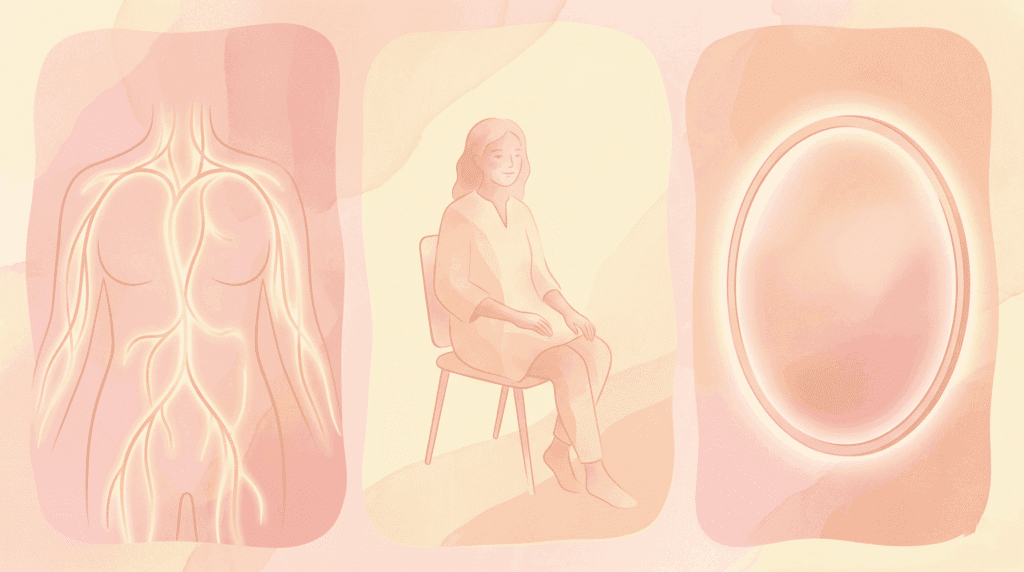
Graded Motor Imagery Exercises for Chronic Pain: Training the Brain to Relate to Movement Safely
For readers who want to explore Graded Motor Imagery in more depth, this section offers a fuller step-by-step version of the method. It is not essential for using the rest of the page, so you can leave it for later and return when it feels useful.
Best for: option A (avoidance), or days when physical activity feels intimidating
Use: when you want to rebuild confidence in movement through mental and visual training
What it does: introduces a sequence of three exercises that help your brain reconnect with the body without triggering alarm. By practicing recognition, imagination, and visual feedback, you gradually reduce threat signals linked to activity.
Stage 1 – Left / Right Recognition
Sharpening the body map
Instructions
Set aside about 15-20 minutes in a quiet place. If at any moment this activity feels frustrating or tiring, pause and take a few slow breaths before continuing. This stage trains your ability to quickly recognize whether a limb belongs to the left or right side. When pain has been present for a long time, the brain’s internal map of the body can become less precise.
Practicing this simple recognition task helps rebuild that clarity without requiring any physical movement.
What you need:
• A magazine, catalog, or newspaper
• A pen or marker
Part I – Find the Images
Flip through the pages and look for pictures that show hands or feet. Each time you find one:
- Look at the image and decide quickly:
“Is this left or right?” - Circle the limb.
- Write a small L or R next to it.
Continue until you have marked about 20-30 images.
Part II – Speed Practice
Return to the first page you marked. Now go through the images again as quickly as you can.
Your goals are simple:
• Say “left” or “right” within about two seconds
• Aim for around 80% accuracy
If you hesitate, skip that image and move to the next one.
Important Cue
If you notice yourself copying the position with your own hand or foot, pause. That usually means the brain is trying to simulate the movement physically instead of recognizing it visually. For this stage, the goal is quick visual recognition, not imitation.
Why this helps
Practicing this skill supports three important changes:
• Precision: the internal map of the body becomes clearer
• Safety learning: attention can engage with body parts without triggering alarm
• Calm observation: one notices sensations without immediate protection.
Success signal
You have likely practiced this stage enough when it feels easy and even a little boring. “Boring” is a good sign; it means the nervous system is no longer treating these images as something threatening or difficult.
Moving forward
If you are reaching about 80% accuracy and responding within a couple of seconds, your body map is probably clear enough to begin Stage 2: Imagined Movement. If it still feels challenging, spending more time here can make the next stage easier.
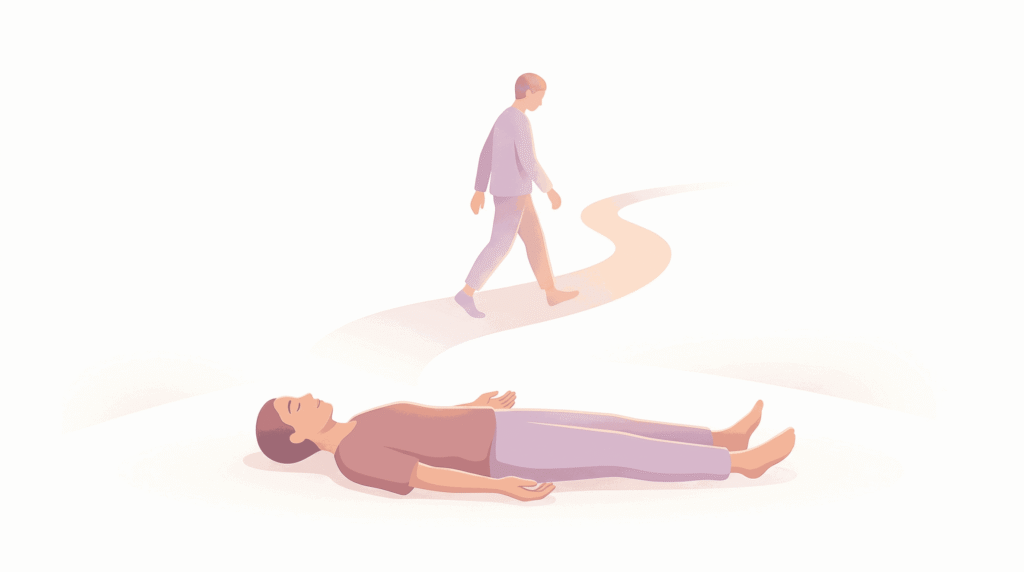
Stage 2 – Imagined Movement
Rehearsing Safe Activity
Instructions
Set aside about 20 minutes in a quiet, comfortable place. This stage involves mentally rehearsing an activity before doing it physically. When you imagine performing an action, many of the same brain areas activate as when you actually carry it out.
Practicing this kind of visualization helps the nervous system experience the activity as safer and more manageable, which can reduce protective alarm signals linked to it.
What you need:
• A notebook and a pen
Part I – Choose the Activity
Start by identifying an activity or position that currently feels somewhat intimidating or likely to trigger discomfort. Pick one to work with. If the task feels too large right now, scale it down to a smaller version.
Examples:
• If sitting for hours feels overwhelming, begin with sitting for ten minutes
• If walking long distances feels difficult, start with walking around the block
Once you have chosen the activity, spend about five minutes watching others perform it with ease. You can find examples in photos or short videos online. Pay attention to how relaxed and fluid the movement appears.
Part II – Mental Rehearsal
When you feel ready, close your eyes. For about five minutes, imagine yourself performing the same activity.
Picture the scene as clearly as you can:
• Your body moving smoothly
• Muscles staying loose
• The activity happening without restriction or fear
Try to experience the action from the inside, as if you are the person performing it.
Part III – Practicing in Different Places
Next, think of three or four real-life places where you would like to do this activity. Examples might include: sitting at a desk, in a theater, at a friend’s dining table, or in a car.
Close your eyes again and spend about ten minutes imagining yourself doing the activity comfortably in each of these environments. Notice the details of each setting: the chair’s support, the surrounding sounds, and the room’s light and atmosphere. Allow the activity to unfold calmly in each place.
Part IV – Reflection
Take five to ten minutes to write what you noticed.
You might reflect on:
• sensations or moods that appeared during visualization
• anything that felt surprising
• whether imagining the activity felt comfortable or challenging
You can also ask yourself:
“Can simply thinking about a movement actually damage my body’s tissues?”
Finally, note why being able to do this activity again matters to you personally.
Why this helps
This stage trains the nervous system in two important ways:
• Preparation: rehearsing actions in a calm mental environment helps the body feel more relaxed when the activity happens in real life.
• Reducing alarm: repeatedly visualizing successful movement teaches the brain that the activity itself is not a threat.
Success signal
You are likely ready to move forward when you can imagine these scenarios clearly while remaining calm and comfortable. When the visualization feels easy or even a little boring, the nervous system has usually become more familiar with the activity. You can naturally include short mental rehearsals throughout your day at that point.
Try the guided version
If you’d like support with this step, you can follow the guided meditation Graded Motor Imagery for Chronic Pain: Imagining Movement Safely.
This audio walks you through the visualization process and helps you rehearse the activity in a calm, structured way.
→ Listen to the guided session
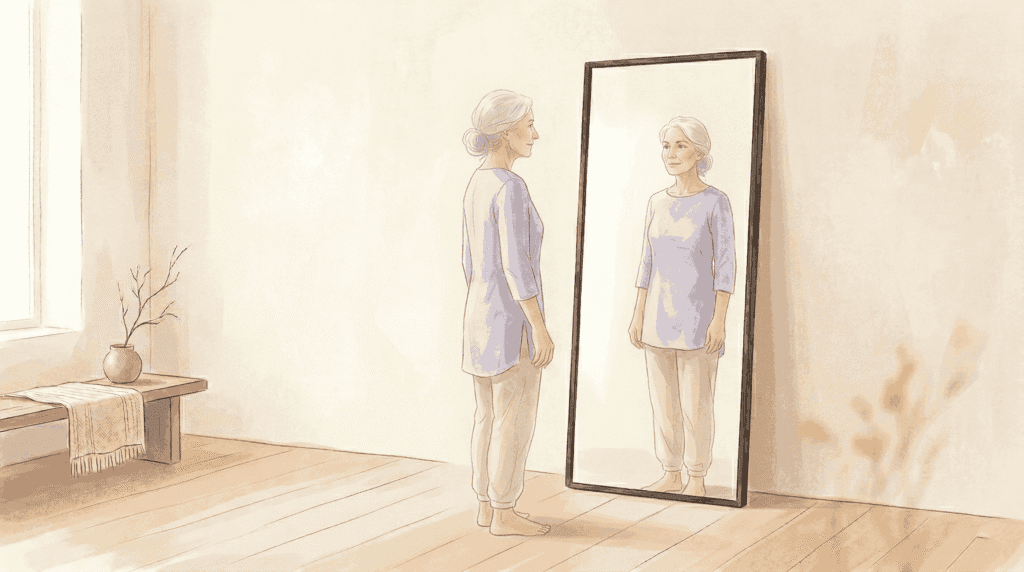
Stage 3 – Mirror-Based Movement Awareness
Seeing Safe Motion
Instructions
Find a quiet place where you can stand or sit comfortably in front of a large mirror for about 15 min. This stage uses visual feedback to help the nervous system reinterpret sensations in the back. When the body sees itself moving calmly and smoothly, it often reduces the protective tightening that can make the spine feel stiff or guarded.
What you need:
• A large mirror (a full-length or wide wall mirror works best)
Part I – Setting the Scene
Stand or sit sideways to the mirror so that one side of your torso faces the glass. Turn your head to look at your reflection and focus on the half of your torso you can see. For a moment, imagine that what you see represents your whole back moving freely and comfortably. Take a few slow breaths while watching the reflection remain relaxed.
Part II – Gentle Motion
When you feel ready, introduce a small movement.
Examples include:
• a tiny pelvic tilt (tucking the tailbone)
• a slight side bend toward the mirror
Keep the motion minimal. As you move, watch the reflection closely and notice how the torso shifts with ease. Allow the hidden side of the back to follow the same soft pattern you see in the mirror. The goal is subtle motion; so small it might barely be visible to someone else.
Part III – Sensory Integration
While observing the reflection, imagine the spine moving like a flexible chain, where each segment adjusts gently and independently. If you notice tightening or protective bracing, pause. Return to stillness and take a few slow breaths while looking at the reflection until the body settles again. Then continue when it feels comfortable.
Why this helps
This stage supports several changes in the nervous system:
• Reframing stiffness: seeing the torso move freely challenges the internal sense of being “stuck.”
• Reducing guarding: visual feedback often softens protective muscle tension.
• Restoring trust: the system learns that spinal motion can occur without triggering an alarm.
Success signal
You have likely practiced enough when these small motions feel calm and unremarkable. When the experience becomes easy, or even a little boring, it usually means the nervous system interprets back motion as safe.
If you got this far,
Get Support in Your Inbox
Subscribe to the newsletter and let me help you turn confusion into clarity. The PDF I have prepared is a guide that will help you organise all the elements of your condition: symptoms, treatments and impact, so you can understand your pain behaviour. This is truly important for explaining it to healthcare professionals, loved ones and yourself.
“Clinical Clarity Workbook – A map for precise diagnosis“
Until next time,
Alina